The Last Known Moment
True crime episodes covering underreported cases, with a focus on the last known moments before a disappearance or death, and where the case stands today.
The Last Known Moment: The Death of Brenda Lee Rawls
Two Black women died in Bridgeport, Connecticut, on the exact same day — December 12, 2021. One case, Lauren Smith-Fields' (covered in full back in Episode 7), went viral. This episode belongs to the other woman: Brenda Lee Rawls. Brenda was 53, a longtime Bridgeport resident who was, by every account her family has given, deeply known and deeply loved in her community. More than two months after she was found dead in her home, Connecticut's Chief Medical Examiner ruled her death natural — cardiovascular disease, with diabetes as a contributing factor. For her family, that ruling was not the end of it: they say Bridgeport Police never notified them, and that she was treated like a Jane Doe. In this episode of The Last Known Moment, we walk through Brenda's story on its own terms — the timeline of that day, the two detectives suspended (and later reinstated) for how they handled both her case and Lauren's, the federal civil rights lawsuit that followed, and why we're not letting her case be folded into someone else's.
- -Brenda Lee Rawls, 53, was found dead in her Bridgeport, Connecticut home on December 12, 2021 — the same day and city as Lauren Smith-Fields' death
- -Connecticut's Chief Medical Examiner ruled her death natural on February 25, 2022 — cardiovascular disease, with diabetes as a contributing factor
- -Family says Bridgeport Police never notified them of her death and that she was treated like a Jane Doe
- -Detectives Angel Llanos and Kevin Cronin were suspended on January 30, 2022 for mishandling both Rawls' and Smith-Fields' cases; both were later reinstated on appeal
- -Rawls' family filed a federal civil rights lawsuit against the city, seeking damages alongside Smith-Fields' family
- -In February 2025, a federal judge dismissed the civil rights claims in both lawsuits, finding no evidence race played a role in how either case was handled
- -No settlement has been confirmed in Rawls' case as of this recording, and her family's calls for an independent investigation remain unanswered
The Last Known Moment: The Grim Sleeper's Unidentified Victims
Between 1984 and 2007, Lonnie David Franklin Jr. — later nicknamed the "Grim Sleeper" for an apparent 14-year gap in his crimes — murdered women across South Los Angeles. In 2016 he was convicted of killing nine women and a teenage girl, sentenced to death, and died in prison in 2020. That much is settled record. What isn't settled is what happened to the rest of the women in his photo collection. When Franklin was arrested in July 2010, investigators recovered almost 1,000 photographs and hours of video from his home. In December 2010, the LAPD took the unusual step of releasing 180 of those images publicly, hoping someone would recognize a face. Years later, a significant number of those women have still never been identified. In this episode of The Last Known Moment, we cover how this case was cracked open by a reporter the department ignored, how familial DNA and a discarded pizza crust led to Franklin's arrest, the ten women a jury named in its verdict, the additional suspected victims prosecutors presented but never charged, the two women who survived him — and the unidentified women still waiting for their names back.
- -Lonnie David Franklin Jr. (the "Grim Sleeper") was convicted in 2016 of murdering nine women and a teenage girl in South Los Angeles between 1985 and 2007; he died in prison in 2020
- -Ten confirmed victims named at trial: Debra Jackson (29), Henrietta Wright (35), Barbara Ware (23), Bernita Sparks (26), Mary Lowe (26), Lachrica Jefferson (22), Alicia Alexander (18), Princess Berthomieux (15), Valerie McCorvey (35), and Janecia Peters (25)
- -Four additional suspected victims — Sharon Dismuke, Inez Warren, Georgia Mae Thomas, and Rolenia Morris — were presented at sentencing but never charged
- -Two known survivors: Enietra Washington (1988) and Fredia Gibbs (1993)
- -Investigators recovered almost 1,000 photographs and hours of video from Franklin's home; the LAPD publicly released 180 of them in December 2010 seeking help identifying the women
- -A significant number of the women in those photographs have never been identified, even years after the public appeal
- -The case was cracked open by LA Weekly reporter Christine Pelisek's investigative reporting, and Franklin was arrested via familial DNA and a discarded pizza crust used for a covert DNA match
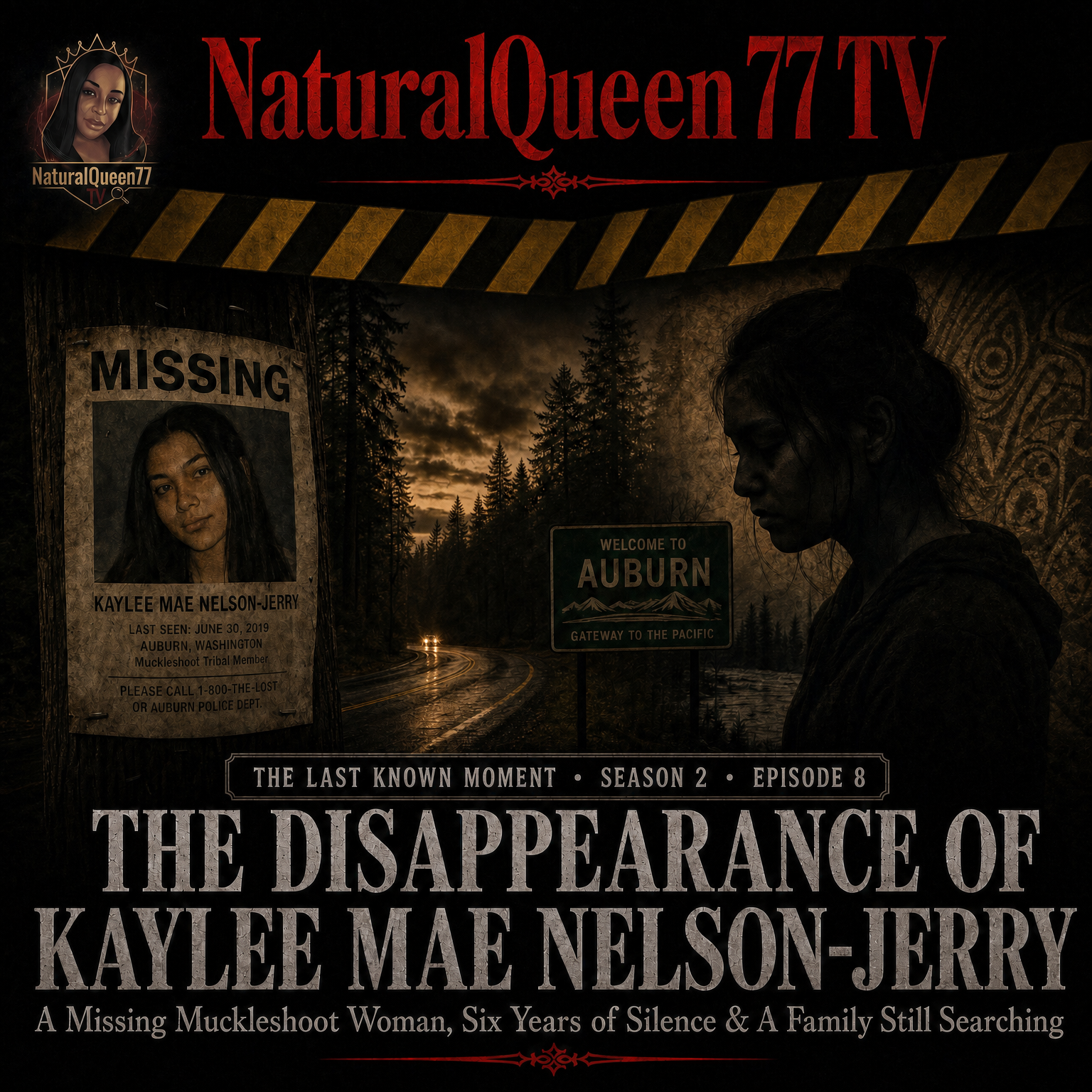
The Last Known Moment: The Disappearance of Kaylee Mae Nelson-Jerry
On June 30, 2019, 21-year-old Kaylee Mae Nelson-Jerry, a member of the Muckleshoot Indian Tribe, was last seen in Auburn, Washington. She has never been seen or heard from again. Unconfirmed sightings have surfaced in Seattle, Tacoma, and Spokane over the years, but none have ever been verified, and no suspect has ever been named. This is not a cold case in the sense of a resolved crime we're looking back on — it's an active, unsolved missing persons case, and we're covering it because Kaylee's story deserves to be heard and her family is still waiting for real answers. More than seven years later, her aunt Tammy Byers says the family will never stop looking for her. In this episode of The Last Known Moment, we walk through what's publicly known about Kaylee's disappearance, the investigation led jointly by the Auburn Police Department and the Muckleshoot Indian Tribe Police Department, and the broader Missing and Murdered Indigenous Persons crisis that her case is part of.
- -June 30, 2019 — Kaylee Mae Nelson-Jerry, 21, was last seen in Auburn, Washington; she has never been found
- -A member of the Muckleshoot Indian Tribe, she lived on the Muckleshoot Reservation
- -Classified as an Endangered Missing Person (Source: The Charley Project, NamUs #MP62474)
- -Unconfirmed sighting reports have surfaced in Seattle, Tacoma, and Spokane; none have been verified
- -Investigation led jointly by the Auburn Police Department and the Muckleshoot Indian Tribe Police Department
- -A King County Sheriff's Office detective specializing in Missing and Murdered Indigenous Persons cold cases is also working the case
- -More than seven years later, no suspect has ever been named and her family is still waiting for answers
The Last Known Moment: The Death of Lauren Smith-Fields
Lauren Smith-Fields was 23 — a Stanford High School track star studying cosmetology at Norwalk Community College who ran her own small business on the side — when she matched with a man on Bumble in December 2021. They met in person for the first time on the night of December 11 at her Bridgeport apartment. Early the next morning, he called 911 after finding her unresponsive. The Connecticut Office of the Chief Medical Examiner ruled her death an accident, caused by acute intoxication from fentanyl, the sedating antihistamines promethazine and hydroxyzine, and alcohol. What turned this from a tragedy into a scandal was what happened next: Lauren's family says Bridgeport police never called them. They learned she was dead two days later from a note taped to her apartment door. Key evidence at the scene — bloodied sheets, drinks, a pill, and a condom — reportedly went uncollected for two weeks, and the man who was with her that night was, according to the family, never seriously treated as a person of interest. When the story broke in January 2022, it exploded online — Cardi B tweeted about it, and #JusticeForLauren spread across TikTok and Instagram, raising hard questions about whether race shaped how the case was handled. Two Bridgeport detectives were suspended over their handling of Lauren's case and a nearly identical case involving Brenda Lee Rawls, though both suspensions were later reversed on appeal. Connecticut passed a new law requiring police to notify families within 24 hours of a loved one's death — legislation that exists directly because of what happened to Lauren's family. In this episode of The Last Known Moment, we walk through the timeline of that night, the family's fight to be heard, the federal civil rights lawsuit that followed, and where the case — and a proposed city settlement — stands today.
- -Lauren Smith-Fields, 23, met a man on Bumble and was found dead the next morning in her Bridgeport apartment on December 12, 2021
- -Medical examiner ruled her death accidental — acute intoxication from fentanyl, promethazine, hydroxyzine, and alcohol
- -Family says Bridgeport police never notified them; they learned of her death from a note taped to her apartment door two days later
- -Key evidence reportedly wasn't collected for two weeks, and the man with her that night was never treated as a person of interest
- -Case went viral in January 2022 with support from Cardi B and #JusticeForLauren, raising questions of racial bias
- -Two detectives were suspended (later reversed on appeal); Connecticut passed a law requiring 24-hour family notification
- -2023 federal civil rights lawsuit's racial-bias claims were dismissed in Feb 2025; a ~$30,000 city settlement was still moving through approval as of this recording
The Last Known Moment: The Murder of Kei'Mani Latigue
Kei'Mani Latigue was thirteen years old — an honor-roll student at Spring Elementary School in Toledo, Ohio, days from her fourteenth birthday — when she was reported missing on March 18, 2025. Six days later, her body was found inside an abandoned, burned house on Miami Street in East Toledo. The Lucas County Coroner's Office ruled her death a homicide, caused by multiple incised wounds to the neck. Her father, Darnell Jones, was charged with her murder within hours and was shot by police the following day while evading arrest. Jones has since been charged with capital murder, with prosecutors seeking the death penalty. His defense has twice tried to have the death penalty specifications removed, and in December 2025 the court ordered an evaluation over a claimed serious mental illness. In January 2026, a judge denied three defense motions to suppress evidence gathered from Jones's home and vehicle. Then, in August 2026, the case widened unexpectedly: Lucas County Prosecutor Julia Bates announced a new indictment against Jones on seven counts of rape, four counts of kidnapping, one count of strangulation, and one count of gross sexual imposition — allegations connected to other victims, unrelated to Kei'Mani, spanning 2013 to 2024. In this episode of The Last Known Moment, we walk through the timeline of Kei'Mani's disappearance and death, the Lucas County Children Services controversy that followed, and this month's newly expanded set of charges against her father.
- -Kei'Mani Latigue, 13, was reported missing from her grandmother's home in North Toledo on March 18, 2025
- -Her body was found six days later in an abandoned, burned house on Miami Street in East Toledo; the coroner ruled her death a homicide
- -Her father, Darnell Jones, was charged with her murder and shot by police the next day while evading arrest
- -Jones faces capital murder charges; a judge has twice denied motions to drop the death penalty specifications
- -In January 2026, a judge denied three defense motions to suppress evidence from Jones's home and vehicle
- -In August 2026, Jones was indicted on 7 counts of rape, 4 counts of kidnapping, 1 count of strangulation, and 1 count of gross sexual imposition tied to other alleged victims from 2013–2024
- -Lucas County Children Services faced public backlash after its internal review found no evidence to remove Kei'Mani from her home
The Last Known Moment: Chicago's Unforgotten 51
Between 2001 and 2018, at least 51 women — most of them Black, ages 18 to 58 — were found strangled or asphyxiated across Chicago's South and West Sides. Many were navigating addiction or survival sex work, circumstances that, according to reporting, contributed to years of minimal media and investigative urgency. In 2018, statistician Thomas Hargrove ran the cases through an algorithm built by his organization, the Murder Accountability Project, which flagged a statistical pattern consistent with one or more serial killers. Chicago Police have publicly rejected that theory, stating there is no confirmed evidence linking the cases. Only one arrest has ever come from the pattern: in January 2020, Arthur Hilliard was charged with the 2017 murder of 21-year-old Diamond Turner. DNA was collected from just 18 of the 51 victims, and none of those samples cross-matched each other. In February 2020, Roosevelt University journalism professor John W. Fountain and his students launched "Unforgotten," a project profiling ten of the victims by name — including Gwendolyn Williams, whose 2002 murder produced a 2018 DNA match that never led to charges. In this episode of The Last Known Moment, we walk through the pattern the algorithm found, the one conviction the case has produced, and the students who set out to make sure these women were remembered as more than a statistic. This case remains open, unresolved, and in nearly all of these deaths, uncharged.
- -At least 51 women, mostly Black, were found strangled or asphyxiated across Chicago's South and West Sides between 2001 and 2018
- -In 2018, the Murder Accountability Project's algorithm flagged a statistical pattern consistent with one or more serial killers
- -Chicago Police have publicly stated there is no confirmed evidence linking the cases to a single offender
- -Only one arrest has ever resulted: Arthur Hilliard, charged in January 2020 with the 2017 murder of 21-year-old Diamond Turner
- -DNA was collected from just 18 of the 51 victims, and none of those samples cross-matched one another
- -Roosevelt University's "Unforgotten" project (launched February 2020) profiled ten victims by name, including Gwendolyn Williams
- -Williams' 2002 murder produced a 2018 DNA match to a suspect in Tampa, FL, that never led to charges
The Last Known Moment: The Lost Girls of Rocky Mount
Between 2005 and 2010, at least ten Black women disappeared from Rocky Mount, North Carolina, and the surrounding Edgecombe and Halifax counties. Eight bodies were eventually recovered, most of them along or near a rural stretch known as Seven Bridges Road. Joyce Renee Durham has never been found. Most of the victims were navigating addiction, and several had histories of survival sex work — circumstances that, according to reporting and community accounts, contributed to a slower, less urgent police and media response than cases involving other victims in the same area. The break in the case came through 28-year-old Taraha Shenice Nicholson, reported missing on February 22, 2009 and found less than two weeks later near Seven Bridges Road, strangled. DNA recovered from her body was matched to Antwan Maurice Pittman, a Rocky Mount native with a long prior criminal record. Pittman was arrested as a fugitive in Nash County in August 2009 and charged with Nicholson's murder that September. He admitted at trial to paying her for sex six days before her body was found. In September 2011, a jury convicted him of Nicholson's murder, and he was sentenced to life in prison without parole. In this episode of The Last Known Moment, we walk through the case timeline, the ten women at the center of it, the investigation that finally produced a DNA match, and the systemic neglect — race, poverty, and addiction — that let this pattern continue for years with almost no national attention. Antwan Pittman has never been charged in the other nine deaths, though investigators have said on the record they believe he is connected, since the killings stopped after his arrest. As of this recording, Joyce Renee Durham remains missing, and no one has been held accountable for the deaths beyond Taraha Nicholson's.
- -Between 2005 and 2010, at least ten Black women disappeared from Rocky Mount, NC and surrounding Edgecombe/Halifax counties
- -Eight bodies were recovered, many near a rural stretch known as Seven Bridges Road; Joyce Renee Durham has never been found
- -DNA evidence linked Antwan Maurice Pittman to the 2009 murder of 28-year-old Taraha Shenice Nicholson
- -Pittman was convicted of Nicholson's murder in September 2011 and sentenced to life without parole — the case's only conviction
- -He has never been charged in the other nine deaths, though investigators believe he is connected since the killings stopped after his arrest
- -A 2018 play, "Seven Bridges Road," was written to highlight the disparity in attention these cases received compared to others in the same town
- -A 2012 charity motorcycle ride was held in Rocky Mount to raise awareness for the victims
The Last Known Moment: The Disappearance of Khadijah Rose Britton
On the night of February 7, 2018, Khadijah Rose Britton was at a friend's home in Covelo, California, when her ex-boyfriend, Negie Tony Fallis IV, allegedly showed up armed with a gun, along with his new girlfriend. Witnesses say a physical struggle broke out and Khadijah — a 23-year-old member of the Round Valley Indian Tribes known to loved ones as "Deej" — was forced into a vehicle at gunpoint. She has not been seen or heard from since. Khadijah had a documented history of domestic violence with Fallis, including an attack with a hammer weeks before she vanished. She had reported it to police, then later told them she didn't want to pursue charges — a pattern domestic violence advocates say is tragically common. Ten days after her disappearance, Fallis was charged with kidnapping, attempted murder, and domestic violence. In June 2018, prosecutors dropped those charges for insufficient evidence; Fallis ultimately pleaded no contest only to a reduced firearms charge. No one has ever been charged in connection with Khadijah's disappearance itself. In this episode of The Last Known Moment, we walk through the last known moment, the investigation's early stumbles, the reward that has grown into six figures, and the broader Missing and Murdered Indigenous Persons crisis that Khadijah's case has come to represent. We also address, directly and on the record, a false claim currently circulating online that her remains have been recovered — a claim no law enforcement agency has confirmed. As of this recording, Khadijah Rose Britton's case remains open. She has not been found.
- -February 7, 2018 — Khadijah Rose Britton, 23, was forced into a vehicle at gunpoint by her ex-boyfriend outside a friend's home in Covelo, California
- -A member of the Round Valley Indian Tribes (Wailacki and Yuki descent), known to loved ones as "Deej"
- -She had reported domestic violence — including an attack with a hammer — against her ex-boyfriend weeks earlier, then withdrew the complaint
- -Ten days after she vanished, her ex-boyfriend was charged with kidnapping, attempted murder, and domestic violence
- -In June 2018, those charges were dropped for insufficient evidence; he pleaded no contest only to a reduced firearms charge
- -No one has ever been charged in connection with Khadijah's disappearance itself
- -The reward for information has grown from an initial $50,000 toward as much as $85,000 over the years
- -Her case is part of the broader Missing and Murdered Indigenous Persons crisis in California
- -A false claim currently circulating online says her remains have been found — no official source confirms this; her case remains open and unsolved

The Last Known Moment: The Disappearance of Phoenix Coldon
On December 18, 2011, 23-year-old Phoenix Coldon left her family's home in Spanish Lake, Missouri, behind the wheel of her black 1998 Chevy Blazer. Her father said she was headed somewhere close — maybe a convenience store, maybe a friend's house. She never came back. Just a few hours later, her Blazer was found abandoned roughly 25 minutes from home, across the Missouri-Illinois state line in East Saint Louis, Illinois. Inside were her glasses, her purse, her shoes, her ID, and an old cell phone bill — no sign of a struggle. But because the vehicle was impounded on the Illinois side of the river, it was never cross-referenced against the missing persons report her parents had just filed with Missouri police. The Coldon family says they were never properly notified — a family friend, searching independently, found the Blazer sitting in a tow lot. After that afternoon, every trace of Phoenix went silent. Her phone, her bank accounts, her social media — all activity stopped completely and never resumed. Frustrated with the pace of the official investigation, her parents spent their own money and time chasing leads on their own, a search that eventually cost them their home and their savings. In this episode of The Last Known Moment, we break down the timeline, the jurisdictional failure that may have cost investigators their best early lead, and the competing theories — abduction, a staged disappearance, trafficking — that have circulated for over a decade. As of this recording, Phoenix Coldon has been missing for more than fourteen years. No arrest has been made, and her case remains open.
- -December 18, 2011 — Phoenix Coldon, 23, disappeared after leaving her family's home in Spanish Lake, Missouri
- -Her Blazer was found abandoned about 25 minutes away, across the state line in East Saint Louis, Illinois, within hours
- -Her glasses, purse, shoes, ID, and an old cell phone bill were still inside — no sign of a struggle
- -A jurisdictional mix-up meant the impounded vehicle was never cross-referenced against the Missouri missing persons report
- -The Coldon family says they were never officially notified — a family friend found the car in a tow lot first
- -All phone, bank, and social media activity ceased that day and never resumed
- -The Coldon family spent their life savings and lost their home searching independently for their daughter
- -As of this recording, Phoenix Coldon has been missing for over fourteen years; no arrest has been made
The Last Known Moment: The Death of Phylicia Barnes
On December 28, 2010, sixteen-year-old honor student Phylicia Barnes disappeared from her half-sister's apartment in Northwest Baltimore while visiting from Monroe, North Carolina for winter break. She had told people she planned to go to the mall. She never returned. Michael Maurice Johnson, who was dating Phylicia's half-sister, became an early suspect after witnesses reported seeing him move a large plastic tub out of the apartment the same day she vanished. In April 2011, Phylicia's body was recovered from the Susquehanna River near the Conowingo Dam; the medical examiner ruled her death a homicide by asphyxiation. What followed was one of the most drawn-out legal battles in Maryland criminal court history: an indictment, a second-degree murder conviction overturned for a Brady violation, a mistrial, an acquittal that was itself reversed on appeal, and finally a third trial that ended with a judge's acquittal. Under the law, that acquittal is final — no one has ever been convicted of killing Phylicia Barnes, and Johnson can never be retried for her death. In this episode of The Last Known Moment, we cover the full case history and the most recent development: in June 2026, Johnson was convicted and sentenced to two consecutive life sentences plus 25 years in an unrelated Baltimore County rape and assault case. The judge allowed Phylicia's family to submit victim impact statements at that sentencing — a measure of relief after sixteen years, even though her murder itself remains legally unresolved.
- -December 28, 2010 — Phylicia Barnes reported missing from her half-sister's apartment in Northwest Baltimore
- -Michael Johnson, who was dating Phylicia's half-sister, named an early suspect after witnesses saw him move a large plastic tub from the apartment
- -April 2011 — Phylicia's body recovered from the Susquehanna River near the Conowingo Dam; ruled a homicide by asphyxiation
- -2013 — Johnson convicted of second-degree murder; conviction later overturned for a Brady violation
- -A mistrial, a reversed acquittal, and a third trial that ended with a judge's acquittal — legally final, no retrial possible
- -No one has ever been convicted of killing Phylicia Barnes
- -June 2026 — Johnson sentenced to two consecutive life terms plus 25 years in an unrelated Baltimore County rape and assault case
- -Phylicia's family submitted victim impact statements at that sentencing, calling it a measure of relief after 16 years

The Last Known Moment: The Death of Joyce Carol Vincent
On January 25, 2006, housing officers forced open the door of a bedsit above Wood Green Shopping City in North London — not searching for a body, but dealing with unpaid rent. What they found was a skeleton: the remains of thirty-eight-year-old Joyce Carol Vincent, so decomposed she could only be identified through dental records. Investigators believe Joyce had been dead since December 2003 — meaning her body lay undiscovered in that flat for over two years. The television was still switched on. Wrapped Christmas gifts sat nearby, never opened. An inquest later returned an open verdict: no forced entry, no evidence of foul play, just an ordinary door that nobody thought to check. In this episode of The Last Known Moment, we cover who Joyce really was — a vibrant, socially connected woman before isolation quietly swallowed her final years — the discovery that shocked a nation, and the 2011 documentary Dreams of a Life that finally gave her story a voice. There is no killer in this case. No trial. Just an uncomfortable question about how easily a person can disappear from a crowded city, and how long it can take before anyone notices.
- -January 25, 2006 — housing officers force open Joyce Carol Vincent's bedsit door above Wood Green Shopping City, North London
- -Investigators believe Joyce had been dead since December 2003 — her remains undiscovered for over two years
- -The television was still on; wrapped Christmas gifts sat untouched nearby
- -Joyce was identified through dental records due to the extent of decomposition
- -An inquest returned an open verdict — no forced entry, no evidence of foul play
- -Born in 1965 to Grenadian parents, friends describe a vibrant, socially connected woman before her isolation deepened
- -The 2011 docudrama Dreams of a Life, directed by Carol Morley and starring Zawe Ashton, brought her story to public attention
- -Why an entire community — family, friends, neighbours — failed to notice her absence for over two years

The Last Known Moment: The Disappearance of Keeshae Jacobs
On September 26, 2016, twenty-one-year-old Keeshae Jacobs left her family's home in Richmond, Virginia's East End for a night out. Around 11 p.m., she texted her mother to say she'd made it to her destination safely. It was the last anyone in her family ever heard from her. Keeshae had been in contact with a man named Otis Lee Tucker and was believed to be heading toward his residence. Investigators later found her SIM card and blood-stained items tied to Tucker's home, but without a body or a confession, the case stalled for years. In this episode of The Last Known Moment, we cover Keeshae's disappearance, the mother who refused to stop investigating on her own, the 2022 murder that put Tucker behind bars in Florida, and the 2024 confession — secured with help from Tucker's own father — that finally confirmed Keeshae's death without ever charging anyone for it. Keeshae's case remains classified as exceptionally closed. Her remains have never been recovered.
- -September 26, 2016 — Keeshae's last known movements: a night out in Richmond, and a text to her mother confirming she'd arrived safely
- -Keeshae was 21 years old, known to family as a homebody and "a very sweet and loving person"
- -Her SIM card and blood-stained items were later found tied to the residence of Otis Lee Tucker
- -Richmond Police investigation: what was gathered, what was pursued, and why the case stalled for nearly eight years
- -Toni Jacobs — Keeshae's mother — who investigated independently after being told there wasn't much police could do
- -Otis Tucker's 2022 conviction for the murder of Ashley Fowler in Florida, and how it reopened Keeshae's case
- -The 2024 confession, secured with help from Tucker's father, in which he admitted to disposing of Keeshae's body but not to killing her
- -Richmond Police Chief Rick Edwards' July 2024 announcement confirming Keeshae's death
- -Why the case is classified 'exceptionally closed' and why no charges have ever been filed