⚠️ Content Warning
This article discusses the disappearance of a young woman, systemic failures in law enforcement, violence against Indigenous women, and the MMIW/MMIWG crisis. Some details may be distressing to sensitive readers.
Accuracy Disclaimer: All information in this article has been sourced from FBI records, BIA reports, Congressional testimony, and credible news outlets including The Guardian, ABC News, NBC Montana, the Great Falls Tribune, and A&E. Where details remain unconfirmed, that is stated clearly. This case remains open and active. Nothing in this article constitutes legal accusation.
From the series: The Last Known Moment — A NaturalQueen77 TV True Crime Deep Dive
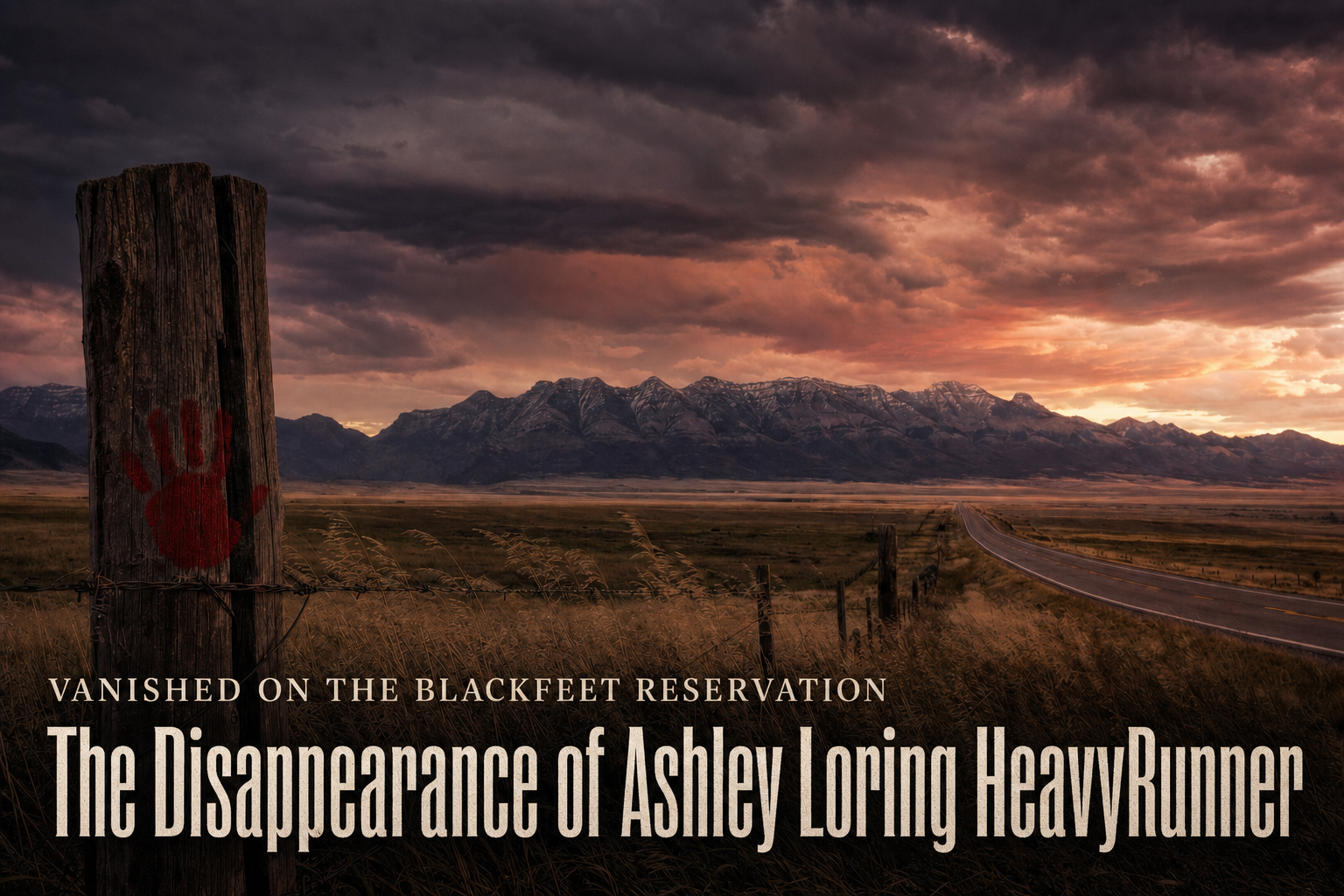
She wanted to be an environmental scientist. She had plans to transfer to the University of Montana, to move in with her big sister, to build a life beyond the reservation she'd grown up on. Ashley Loring HeavyRunner was 20 years old, full of potential, and deeply loved.
And then, sometime after June 5, 2017, she was gone.
What followed is a story that is both specific to Ashley — her family, her community, her last known night — and heartbreakingly universal. It is a story that plays out in a pattern across Indian Country: a young Indigenous woman disappears, the institutions designed to protect her fail to respond, and the family is left to search alone.
Ashley has been missing for nearly nine years. She is still missing.
This is her case.
Who Was Ashley Loring HeavyRunner?
Ashley Loring HeavyRunner was born on November 23, 1996, a member of the Blackfeet Nation in Montana. She grew up on the Blackfeet Indian Reservation in Browning, Montana, a small, tight-knit community on the eastern slope of the Rocky Mountain Front, where Glacier National Park meets the Great Plains.
Friends and family describe Ashley as funny, kind, and sharp. She had a lightness to her that people noticed — the kind of person who made rooms feel warmer.
She was enrolled at Blackfeet Community College as an environmental science student, with her sights set on transferring to the University of Montana to continue her degree. She was making plans. Big ones.
Ashley had an older sister, Kimberly Loring, who would eventually become the most tireless advocate for answers in this case. She also had a father whose health would become part of the chilling timeline of her disappearance.
She was 5 feet, 2 inches tall, weighed approximately 90 pounds, and had dark hair. A distinctive scar in the shape of a checkmark marked one of her hands.
At the time of her disappearance, Ashley was reportedly pregnant.
The Last Known Moment: June 5, 2017
The last confirmed sighting of Ashley Loring HeavyRunner is captured on video.
On the night of June 5, 2017, Ashley attended a party on the Blackfeet Indian Reservation in Browning. Someone filmed that night's gathering, and Ashley appears in the footage — alive, present, unharmed. That video became one of the few pieces of hard evidence in a case that would soon run cold.
After that night, her family didn't hear from her.
At first, no one panicked. Ashley had lost her phone before — it wasn't unusual for her to drop off the radar for a few days. Her family assumed she was staying with a friend. That kind of assumption is what love does: it finds the most reasonable explanation.
But the days stretched on. Then came the moment that turned concern into alarm:
Ashley didn't visit her father in the hospital.
That wasn't like her. Whatever else was going on in her life, Ashley would have been there. Her family began making calls. Her friends confirmed: no one had heard from Ashley since June 5.
Her family contacted Blackfeet Law Enforcement and the Bureau of Indian Affairs (BIA) to report her missing.
The response they received would haunt the case for years.
"No one took it seriously," Ashley's sister Kimberly later told The Guardian. "They just said: 'She's of age, she can leave when she wants to.'"
The Investigation Stalls — Before It Even Begins
A few weeks after Ashley vanished, a tip emerged that should have immediately escalated the investigation.
On the same night Ashley was last seen — June 5, 2017 — a young woman had been spotted running from a vehicle on U.S. Highway 89 on the reservation.
Tribal police and the BIA conducted a three-day search in the area around Highway 89.
Ashley's family searched the same terrain themselves. During those searches, Kimberly made a discovery: a sweater and a pair of boots with what appeared to be red stains. The family believed these items belonged to Ashley. They turned them over to law enforcement.
The sweater was lost by authorities.
It eventually resurfaced, but by then the damage was done: weeks had passed, the trail had gone cold, and the family had still not received any DNA testing results from the items.
Meanwhile, the BIA continued for months to maintain its position that Ashley was an adult who had simply chosen to leave. Two months passed before the BIA focused serious attention on her case. The FBI didn't announce it was joining the investigation until February 2018 — eight months after Ashley was last seen — and by then, investigators acknowledged, the case was already cold.
Fewer than 20 officers are responsible for patrolling 1.5 million acres of reservation land.
The Jurisdiction Problem: A System Built to Fail
Ashley's case didn't just stall because of a few individual failures. It stalled because it ran directly into a structural trap that has been swallowing Indigenous women's cases for decades.
On a reservation, three separate agencies hold potential jurisdiction:
1. Tribal law enforcement (Blackfeet Law Enforcement Services)
2. The Bureau of Indian Affairs (BIA)
3. The FBI
The result is predictable: agencies defer to each other, investigations fall into bureaucratic gaps, and no single entity takes clear ownership.
Legal scholars point to a 1978 Supreme Court decision — Oliphant v. Suquamish Indian Tribe — as a root cause of this crisis. That ruling stripped tribal governments of the ability to prosecute non-Native individuals who commit crimes on reservations. Research consistently shows that Native women are most often victimized by non-Native men.
"Reservations pretty much became pockets of lawlessness, where non-Indians know they can go and commit crimes, and nobody's going to show up, and nobody's going to investigate," said Jordan Gross, a professor at the University of Montana's Alexander Blewett III School of Law.
Ashley disappeared into this gap.
What We Know: The Key Figures
Sam McDonald
A man named Sam McDonald came forward with a significant claim: he stated he had been with Ashley for days after the June 5 party. According to McDonald, on June 11, he drove Ashley to meet someone he knew as "V-Dog."
After dropping Ashley off, McDonald says he fell asleep in his vehicle. When he woke up, Ashley was gone.
Paul Valenzuela (aka "V-Dog")
"V-Dog" was identified as Paul Valenzuela, a man Ashley's family says she had been romantically involved with. Valenzuela had prior convictions for burglary and weapons charges.
If McDonald's account is accurate, June 11, 2017 — not June 5 — may be closer to the actual date Ashley disappeared.
Neither McDonald nor Valenzuela has been arrested or charged.
Kimberly Loring: A Sister Who Refused to Stop
If this case has a spine, it is Kimberly Loring.
Unable to trust institutions to find her sister, Kimberly organized and led more than a hundred search parties across the Blackfeet Reservation. She made calls, sent messages, tracked leads, and built a network of people who wouldn't let Ashley's name disappear.
On December 12, 2018, Kimberly testified before the Senate Committee on Indian Affairs:
*"From the very beginning, both the Blackfeet Tribal Law Enforcement and the BIA have ignored the dire situation that Ashley is in and have allowed the investigation to be handled in a dysfunctional manner."*
"The not-knowing is the worst part," Kimberly told the Great Falls Tribune in 2020. "We are holding on to hope, and we will bring her home. We try to look on the bright side, but we are living a nightmare."
Ashley's Case in the Broader MMIW Crisis
Ashley HeavyRunner is not an outlier. She is part of a pattern so large it constitutes a national human rights emergency.
According to the National Crime Information Center (NCIC), in 2020 alone there were 5,295 reports of missing American Indian and Alaska Native women and girls in the United States.
In some counties, Indigenous women face a murder rate more than 10 times the national average.
The Sovereign Bodies Institute (SBI) maintained a database of 4,749 names and stories of missing and murdered Indigenous individuals as of 2021. The SBI's founder, Annita Hetoevehotohke'e Lucchesi, actually taught Ashley at Blackfeet Community College. She entered Ashley's name into the database herself.
"Tribal sovereignty is the only thing that's going to fix this issue," Lucchesi told the Great Falls Tribune in 2021. "Tribes have to have the self-determination to protect their people and hold perpetrators accountable. Until that happens, there will be no change."
Has the Law Changed?
Savanna's Act, signed into law in 2020, requires the Department of Justice to develop and implement protocols for responding to cases of missing and murdered Native Americans. It is named for Savanna LaFontaine-Greywind, a Native woman murdered in North Dakota in 2017 — the same year Ashley disappeared.
The Not Invisible Act (also 2020) established a commission to develop recommendations for reducing violent crime against Indigenous people.
Both laws represented meaningful acknowledgment at the federal level. But activists point out that acknowledgment and implementation are different things.
Where Things Stand: The Case Today
Nearly nine years after Ashley Loring HeavyRunner was last seen:
- ◦The case is open and active, confirmed by both the FBI and BIA
- ◦No arrests have been made
- ◦No charges have been filed
- ◦No remains have been found
- ◦Ashley's family has still not received DNA testing results from the items Kimberly found
Ashley would be 29 years old today.
If You Have Information
If you have any information about Ashley Loring HeavyRunner's disappearance:
- ◦FBI Salt Lake City Field Office: (801) 579-1400 | (800) CALL-FBI | [tips.fbi.gov](https://tips.fbi.gov)
- ◦BIA Missing and Murdered Unit: Text BIAMMU to 847411 | Call 1-833-560-2065 | Email OJS_MMU@bia.gov
- ◦Blackfeet Law Enforcement Services: (406) 338-4000
All tips can be made anonymously.
Resources & Further Reading
- ◦[FBI Missing Person Listing — Ashley Loring HeavyRunner](https://www.fbi.gov/wanted/kidnap/ashley-loring-heavyrunner)
- ◦[BIA Missing & Murdered Unit](https://www.bia.gov/service/mmu)
- ◦[Sovereign Bodies Institute — MMIW Database](https://www.sovereign-bodies.org/)
- ◦Kimberly Loring's Congressional Testimony, December 12, 2018
- ◦*"A Young Woman Vanishes"* — The Guardian, February 2019
🎙️ Listen to the Episode
This case is covered in depth on The Last Known Moment podcast. New episodes drop every Tuesday.
NaturalQueen77 TV is an independent true crime media channel. We cite court documents and credible sources. We believe these names deserve to be spoken.
If this content affected you, please reach out to the [Crisis Text Line](https://www.crisistextline.org/) by texting HOME to 741741.
NaturalQueen77 TV
True Crime — Told Responsibly
This article is based on publicly available information and is for educational and informational purposes only. NaturalQueen77 TV strives for accuracy but cannot guarantee completeness. Content warnings are provided where applicable.